.svg)
Global high-resolution forecasting is the hard problem in weather science. Getting one location right is straightforward. Getting every location on Earth right, every day, at a resolution fine enough to act on, is a different order of difficulty. The latest improvements to GRAF, our Global High-Resolution Atmospheric Forecasting model, move that line forward.
Most global models trade detail for reach. They cover the planet, but at a resolution so coarse that a single grid cell can swallow an entire metro area, blurring the fronts, storms, and wind fields that operations actually depend on. Higher-resolution models exist, but they are usually regional, so they stop at a border that weather does not respect. GRAF was built to refuse that trade: a single global model, run at kilometer-scale resolution where it counts.
That ambition is why The Weather Company produces 2.2 billion forecasts a day for 2.2 billion locations, and why we serve trillions of API calls a month against a 99.9% uptime SLA. This update is about making each of those forecasts sharper at the source.
What changedVariable-resolution grids, resolved to the kilometer
GRAF's defining feature is a variable-resolution grid. Instead of one fixed spacing across the whole planet, the mesh tightens where the atmosphere is doing something worth resolving and relaxes where it is calm. This latest update refines how and where that tightening happens, pushing the model toward kilometer-scale detail in the regions and conditions that matter most to operations.
The runs are also more frequent. Weather does not wait for a scheduled cycle, and neither should the model that tracks it. More frequent assimilation and model runs mean the forecast reflects conditions closer to now, shrinking the gap between what is happening in the sky and what the model believes is happening.
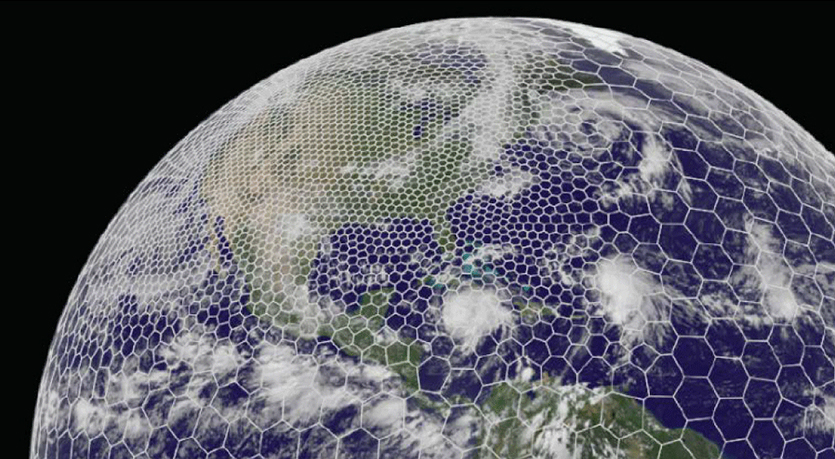
Sharper grids mean higher-definition forecasting. That is the whole point of running the model this way.
Accuracy at the model levelJEDI data assimilation
A forecast is only as good as the picture of the atmosphere it starts from. Data assimilation is the science of building that starting picture, blending millions of live observations from satellites, radar, aircraft, and surface stations into a single coherent state the model can run forward.
The Weather Company delivered the first operational implementation of JEDI, the Joint Effort for Data assimilation Integration, an open, modern assimilation framework built to ingest more observation types and use them more effectively. Improving assimilation improves the forecast at the model level, before a single downstream product is generated. It is the least visible change in this update and one of the most consequential.
This is a discipline we have practiced for a long time. We were reconciling multiple model outputs with statistical and machine-learning methods, in production, long before "AI" became a pitch-deck word. JEDI extends that lineage rather than replacing it.
Why it mattersWhat sharper forecasts change on the ground
Resolution and accuracy are not abstractions to the teams that rely on them. In aviation, weather drives roughly 70% of air-traffic delays, according to the American Meteorological Society. A model that resolves the wind field to the kilometer, and updates it more often, gives dispatchers and airport operations the lead time to move before conditions reach them rather than after.
In energy, sharper forecasts sharpen the load and generation curves that grids and traders plan against. For enterprise and government missions, from supply chains to defense, the value is the same: decisions that can be made earlier and with more confidence, because the forecast underneath them is closer to the truth. This is operational weather intelligence for the missions that cannot wait for certainty.
None of this is slideware. It runs today, at global scale, inside the same platform hundreds of meteorologists and an industry-leading patent portfolio stand behind. The latest GRAF improvements are one more step in a long, unglamorous, compounding effort to make the forecast right.